Say what you mean.
Hear what they meant.
The Kitchen Table is a private app for a parent and their teenager. You message each other like normal — and when a reply stings, or makes no sense, a gentle translator shows what they probably meant and what you could say back.
- Private by default, for both of you
- 14 days of Plus free, no card
- No app store needed
Only the parent sees this reading. Lily never knows it was asked for.
“Fine.” Four letters. About forty meanings.
Most fights between parents and teenagers aren't really about the phone, the curfew or the dishes. They're two people who love each other, hearing something the other didn't quite say.
A teenage brain is being rebuilt from the inside. A parent is carrying work, money and worry their teen never sees. The Kitchen Table sits in the gap between them.
Hover or tap a card. These are the kinds of readings the translator gives.
Five minutes for you. Two for them.
- Step 1You set up your side
Create an account and tell The Kitchen Table a little about your family. It's private to you, and it helps the coach and the translator understand you.
- Step 2Invite your teen with a link and a code
Each teen gets their own private link and a separate access code. You get a short guide on how to bring it up with them — written for your teen, not teens in general.
- Step 3They make it theirs
Your teen creates their own account and decides what you can see. Then you're connected: one private thread, just the two of you. Siblings each get their own.
It works both ways.
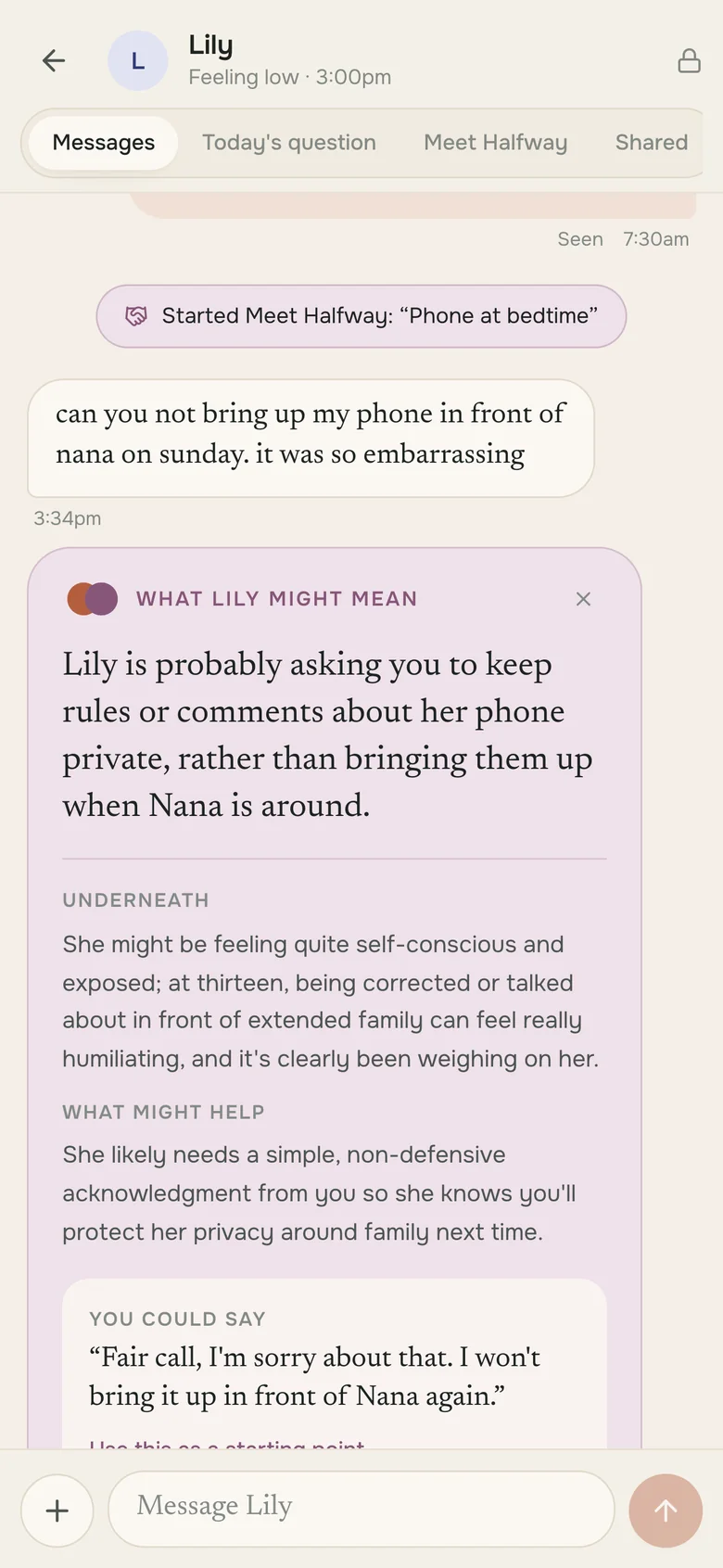
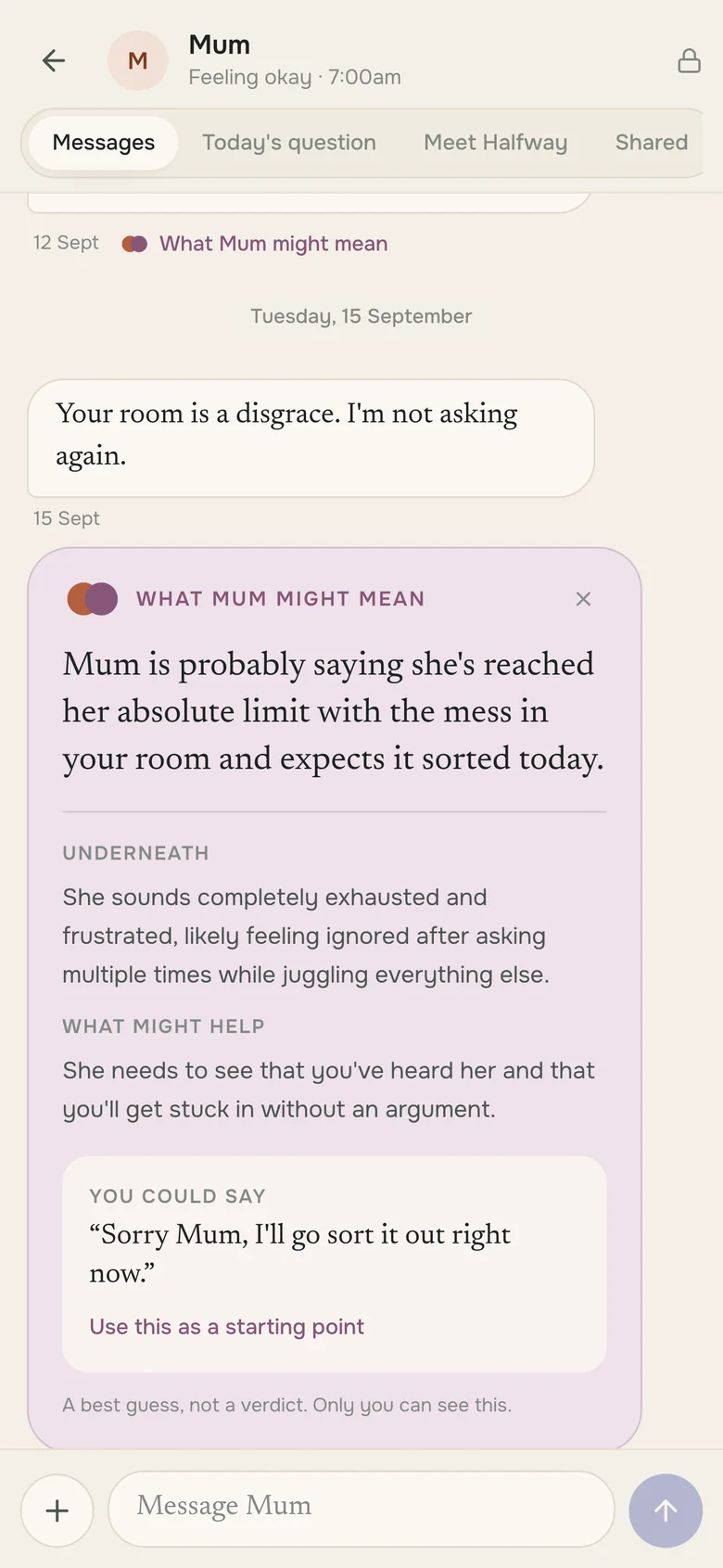
A parent can tap what Lily might mean. A teen can tap what Mum might mean. Each gets a warm, careful reading of what's underneath: the feeling, the need, and one thing they could say back.
It reads the conversation and anything the sender has chosen to share — how they're feeling today, say — so the reading fits the moment. It's only ever shown to the person who asked.
Keep the rule. Lose the fight.
Write the message you want to send, then tap “How will this land?” It shows how the other person is likely to hear it, and offers a version that says exactly the same thing without starting a war.
It never waters down a fair boundary, and it keeps your voice. Only you ever see it.
I need the phone out of your room by 10 on school nights — I've noticed you're wrecked in the mornings. Can we work out a plan together?
Only the writer sees this. Keep your rule — lose the fight.
For the arguments that keep coming back.
Either of you can start one about a specific thing. You each answer four questions privately: what happened from where you stood, how it felt, what you need, what you could give.
Neither of you sees the other's words. You both get one fair summary — each side put generously, what you have in common, and small next steps for both.
- Mum meets Ana's mum before the next one.
- Lily texts at 10pm, and Mum doesn't call.
Thirty seconds that aren't about chores.
Every day, one light question for each parent and teen — sixty of them, from “What's a smell that instantly takes you back to being little?” to “What's something you're proud of that nobody really noticed?”
Answers stay hidden until you've both answered, so there's no copying and no pressure. It's the easiest way to start talking again.
Nana's kitchen on a Sunday — roast lamb and that awful lavender soap.
Sunscreen. Every summer at Mt Maunganui.
Neither sees the other's answer until you've both answered. No copying, no pressure.
Everyone gets a room of their own.
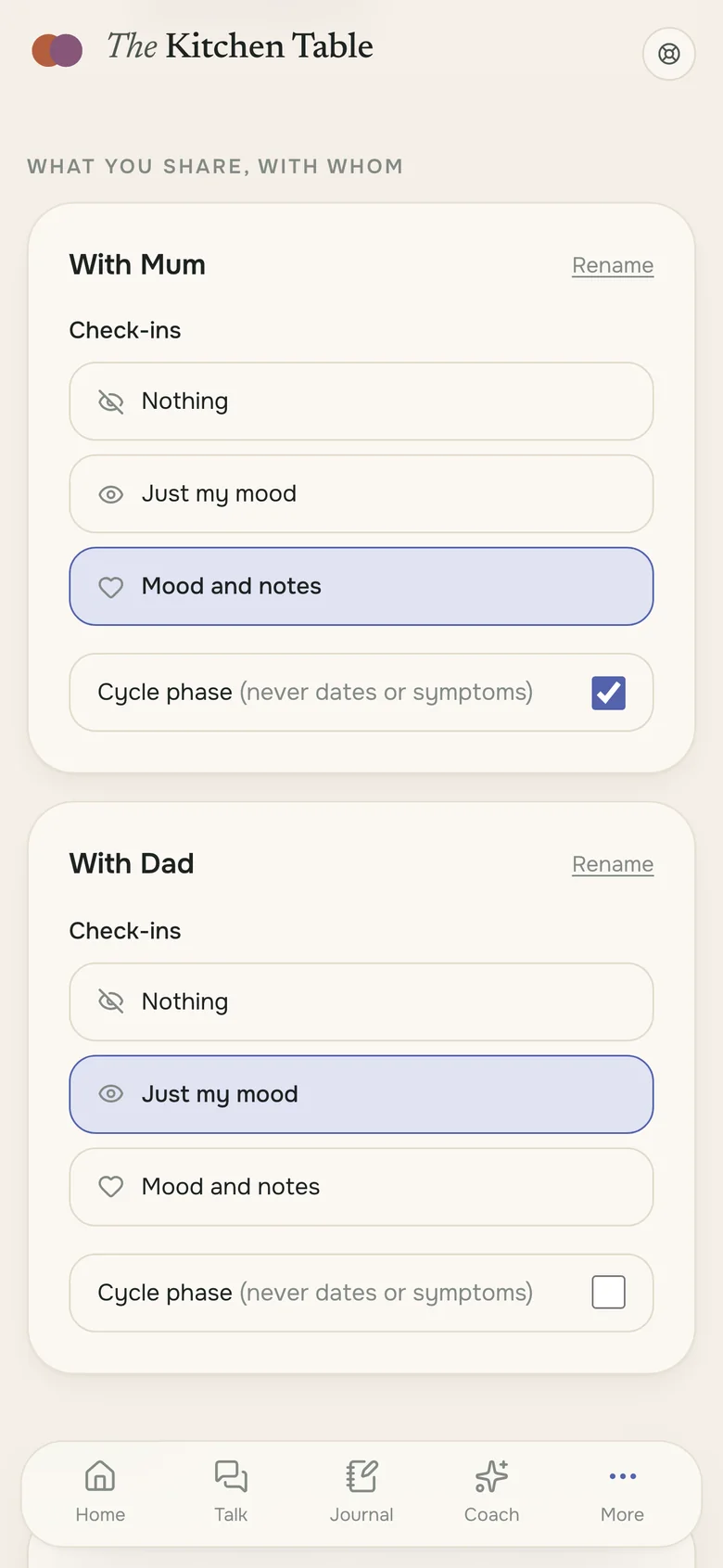
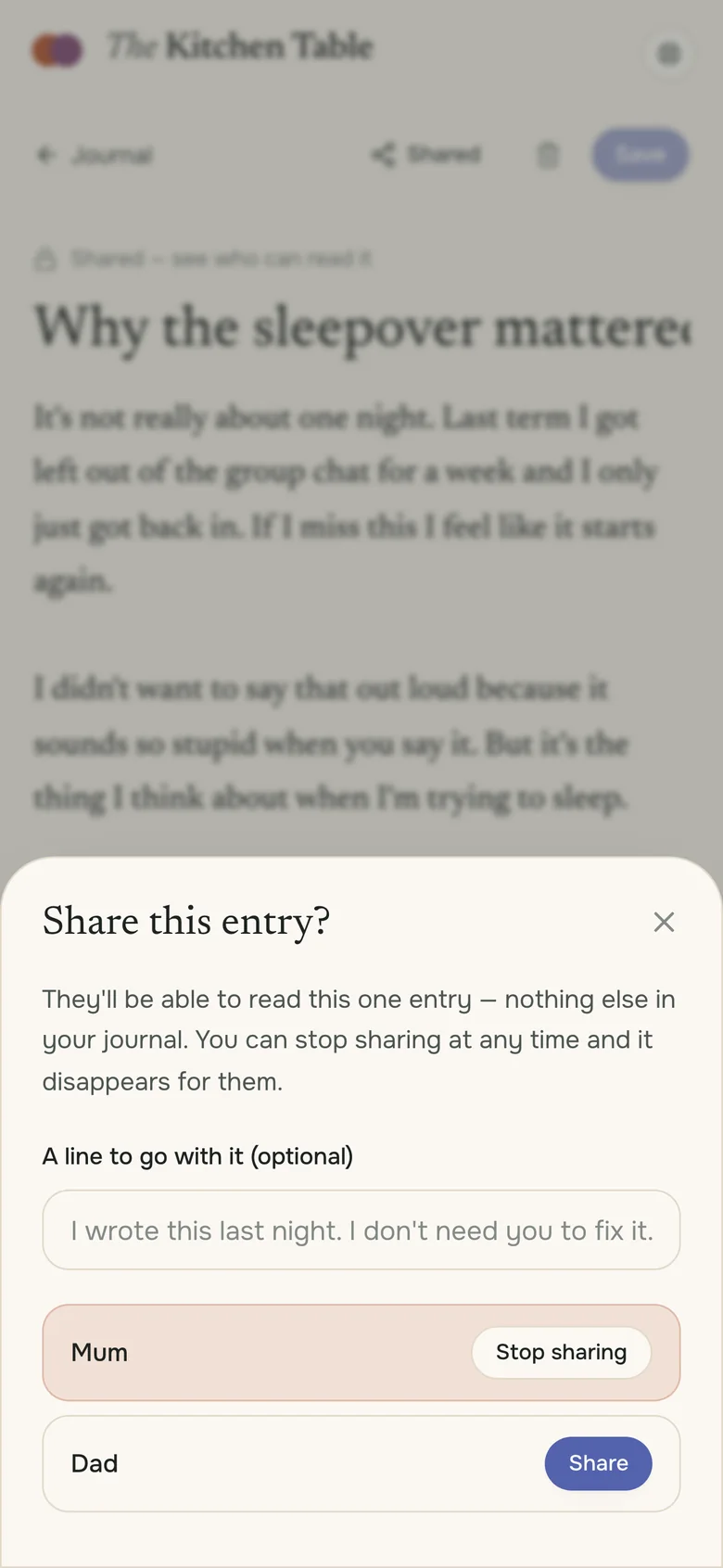
Check-ins, a journal and a cycle tracker for each person. All private by default. Share one journal entry with one person when you're ready, and take it back whenever you like.
Each teen chooses, for each parent, whether they see nothing, just their mood, or the whole check-in. The translator and coach use only what's been shared.
Try it. Each teen chooses, for each parent. Change your mind any time.
Someone to think it through with, before you say it out loud.
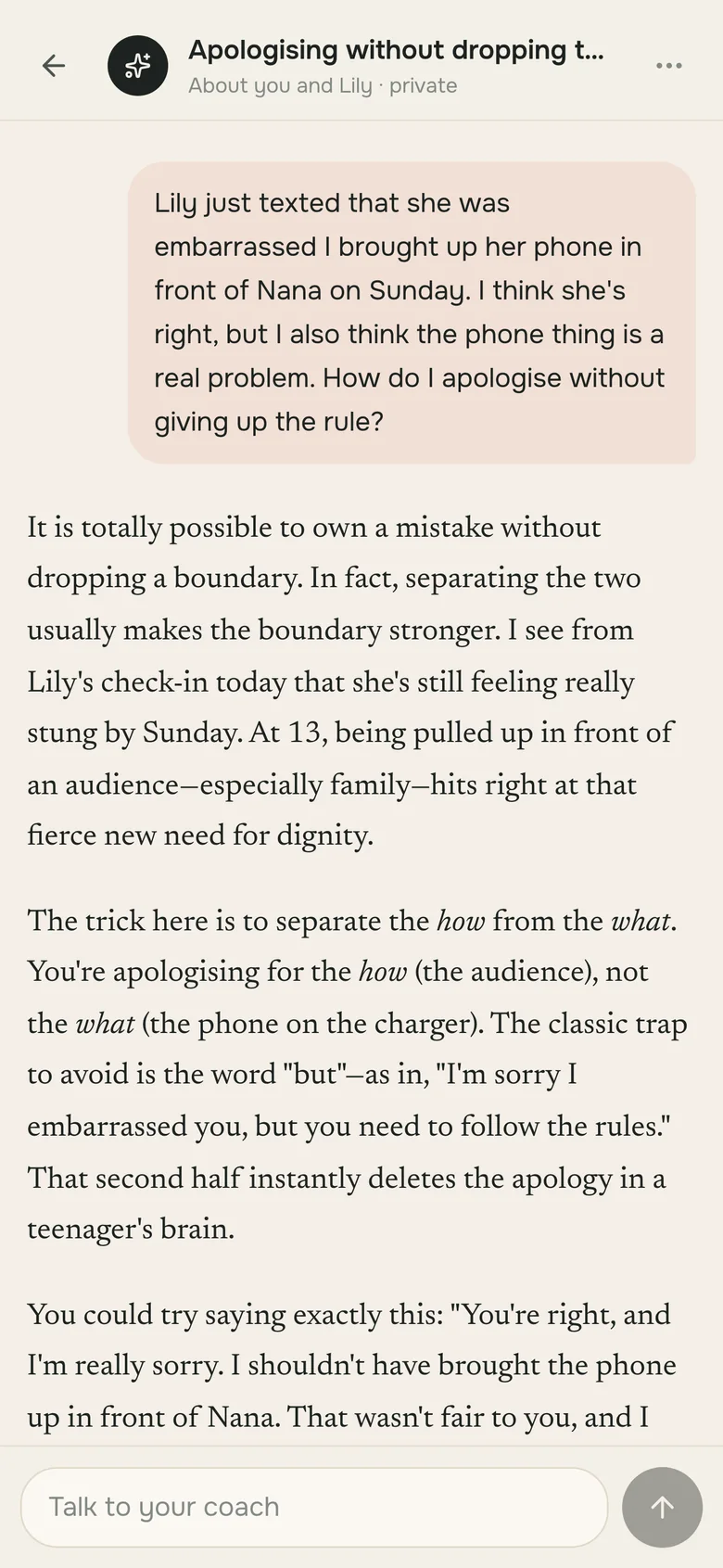
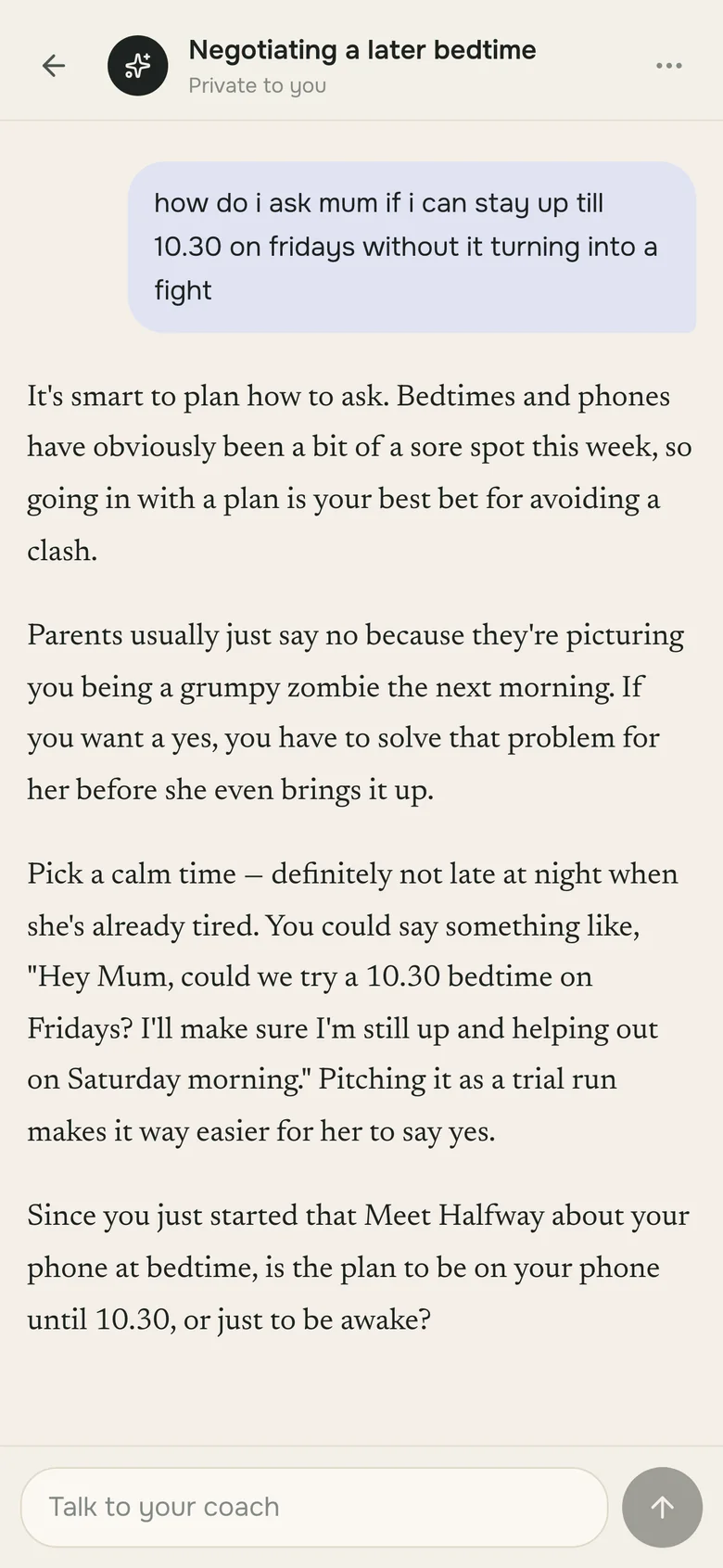
Parents and teens each have their own private coach. It remembers what you've told it (and shows you exactly what it remembers), knows your family, and helps with the real thing in front of you — how to apologise, how to ask for a later bedtime, what to say on the drive home.
It can only see what's yours, or what the other person has chosen to share with you.
This isn't a spying app. Here's the deal.
- Your stuff is yours.
Your journal, check-ins and coach chats are private. Your parent can't see them. Neither can we.
- You decide what they see.
Nothing, just your mood, or more — and you can change it whenever you like.
- It's on your side too.
The translator works on your parent's messages. Your coach can help you ask for things and actually get a yes.
- Nobody gets told behind your back.
If you write something heavy, you'll quietly see who you can talk to. It never alerts anyone.
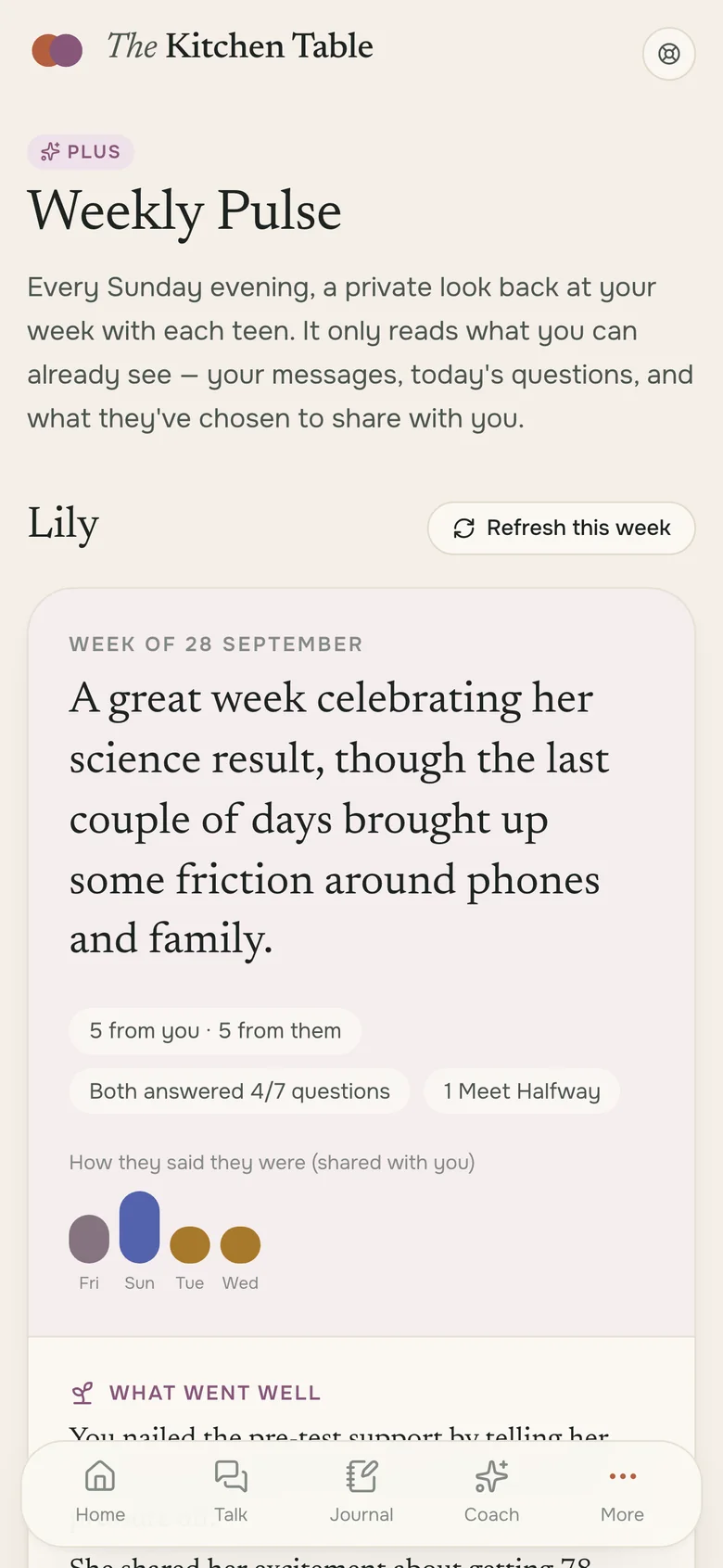
Every Sunday, see the week you actually had.
A private look back at your week with each teen: what went well (parents of teenagers rarely hear it), anything worth a gentle eye, one small thing to try, and a question to ask.
It only reads what you can already see — your messages, today's questions, and what your teen has chosen to share with you.
Nobody sees anything you haven't chosen to share.
A teen won't write honestly if they think a parent is reading over their shoulder. Neither will a parent. So The Kitchen Table is built the other way round.
Read exactly who can see what- A private thread per pair
Each parent and each teen share one thread. Siblings never see each other's.
- Private by default
Journals, check-ins, cycles and coach chats belong to whoever wrote them.
- Encrypted before it's stored
Everything written is encrypted and locked to the person or pair it belongs to.
- Safety without spying
Someone who writes something heavy is shown who can help. Nobody is alerted.
- No ads, no selling data
We're paid by families who find it useful. That's the whole business.
- Yours to delete
Delete your account and everything you wrote goes with it.
Free to start. One price for the whole family.
One subscription covers every parent and every teen in your family. Safety and privacy features are never behind a paywall, and teens are never asked to pay.
Everything you need to start talking, for as long as you like.
- Private messaging between each parent and each teen
- Today's question, check-ins, journals and the cycle tracker
- The full library, and helplines on every screen
- 5 translations and 3 “How will this land?” checks a week each
- 20 coach messages a month each, and one Meet Halfway a month
Every new family gets 14 days of Plus free — no card. One price covers every parent and every teen.
- The translator, as often as you need it
- “How will this land?” before every hard message
- A coach with no meter running
- Meet Halfway whenever it's needed
- Your Weekly Pulse
- One price for the whole family
The things parents ask first.
Is this a way for parents to spy on their teen?+
No — it's built the other way round. A teen's journal, check-ins, cycle log and coach chats are private to them. Parents only ever see messages sent to them, and whatever their teen chooses to share, one thing at a time. The same goes the other way: a parent's private space is private too.
What ages is it for?+
Teenagers roughly 11 to 18, and their parents or caregivers. Parents and teens each get their own version of the library and their own coach, and the coach takes the teen's age into account.
How does the translator work? Is it reading everything?+
When you tap “what they might mean” under a message, the AI reads the recent conversation and anything the sender has chosen to share with you, and offers a careful best guess: the feeling, the need, and something you could say back. It's only shown to you, and the other person isn't told. It never reads anyone's private journal or coach chats.
What if my teen won't use it?+
Common, and fine. When you invite them, The Kitchen Table writes you a short, private guide on how to bring it up with your particular teen — based on what you've told it about them. And the app works for teens on its own terms: their own coach, their own journal, and control over what you see.
Is this therapy or a crisis service?+
No. It's a place to talk and understand each other better, with support that's thoughtful but not professional advice. Every screen has a quiet link to free helplines. If something written sounds like someone might not be safe, the writer is gently shown who can help — nobody is alerted behind their back.
We're separated. Can both parents use it?+
Yes. Invite the other parent — or a step-parent — and each gets their own private thread with each teen. One parent's conversations are never visible to the other.
Do we need to download it from the App Store?+
No. It works in any browser on phone or computer, and you can add it to your home screen in a few taps so it opens like an app and can send notifications. The app walks you through it.
What does it cost?+
It's free to use, with weekly limits on the AI features. Plus is NZ$99 a year or NZ$12.99 a month for the whole family, and every new family gets 14 days of Plus free with no card needed. Teens are never shown prices.
Where is our information kept, and who can read it?+
Everything anyone writes is encrypted before it's stored, and locked to the person or pair it belongs to. It's stored with our database provider in the United States. We don't sell data or show ads. You can delete your account, and everything you wrote, at any time.
The Kitchen Table isn't therapy or a crisis service. Every screen has a quiet link to free helplines. In Aotearoa, call or text 1737 any time, Youthline on 0800 376 633, or Parent Help on 0800 568 856. In an emergency, call 111.
Pull up a chair.
Start with one message, or one question you both answer. It adds up.
Start free — 14 days of Plus includedNo card needed. Works on any phone or computer.